A New Distraction Phantom3dx 2021 [upd] ★ [ Official ]

While there is no single official manual titled "a new distraction phantom3dx 2021," this term appears to refer to a specialized technical field involving medical imaging phantoms and surgical distraction osteogenesis using 3D-printed models. Overview of Phantom3DX (2021)

In a medical context, a "Phantom3DX" (or 3DX phantom) is a specialized tool used to verify and calibrate 3D imaging equipment, such as MRI and CT scanners.

Purpose: It simulates human anatomy to ensure that radiation beams or surgical plans are spatially accurate.

Distraction Osteogenesis: Research from 2021 highlights the use of these phantoms to test new distraction devices—surgical tools used to slowly grow or reshape bone.

3D Technology: These phantoms are often 3D-printed based on patient CT scans to help surgeons practice complex procedures, like mandibular (jaw) distraction. Guide to Using Imaging Phantoms

If you are working with a Phantom3DX device for imaging or surgical planning, follow these general industry protocols:

Setup & Positioning: Carefully align the phantom according to the specific protocol for your imaging modality (e.g., MRI vs. CT). Misalignment can lead to "phantom images" or artifacts that skew data.

Calibration Routine: For new equipment or after maintenance, it is common to scan the phantom multiple times (e.g., four times a day for the first week) to establish a baseline for geometric accuracy.

Field of View (FOV) Testing: Use the 3DX's large FOV to check for spatial distortions at the edges of the image, which is critical for "aiming" radiation beams in cancer treatment.

Surgical Simulation: If using the phantom for distraction osteogenesis, use CAD/CAM software to design the distraction vector before practicing the actual device installation on the 3D-printed model. Potential Software References

The phrase "a new distraction" is also occasionally linked to niche software patches or fixed versions of modeling tools. If you are looking for a guide on software installation or "fixes," be cautious of unofficial sites and prioritize official documentation from vendors like Concordium Software or medical physics databases like PMC.

To draft an essay on " A New Distraction Phantom3DX 2021 ," it is important to clarify the core subject, as "Phantom3DX" typically refers to specific technical or hobbyist equipment, often associated with high-end RC drones or 3D flight simulation peripherals.

Based on current trends in tech and the release cycles of 2021, the following essay explores the "Phantom3DX" as a symbol of the digital escapism that surged during that period.

Essay: The Digital Mirage—The Phantom3DX and the 2021 Era of Distraction

IntroductionThe year 2021 was defined by a unique tension: the world was reopening, yet our reliance on digital "phantoms" had never been higher. Among the various gadgets that emerged to fill the void of social isolation, the Phantom3DX stood out as more than just a piece of hardware. Whether viewed as a high-fidelity flight peripheral or a metaphor for the year’s tech-driven escapism, it represented a "new distraction" that bridged the gap between physical confinement and digital infinity.

The Rise of the High-Fidelity EscapeIn 2021, the tech industry saw a massive spike in demand for immersive experiences. The Phantom3DX a new distraction phantom3dx 2021

, with its emphasis on "3D" maneuverability and precise control, catered to a generation of users looking to navigate spaces they couldn't physically visit. For flight simulator enthusiasts, it wasn't just about gaming; it was about reclaiming a sense of agency and movement. This "new distraction" offered a tactile connection to a virtual world, providing a level of immersion that simple screens could no longer satisfy. The "Phantom" Effect: Presence vs. AbsenceThe naming of the Phantom3DX

is serendipitously apt for the 2021 zeitgeist. Much of our lives during this period were lived "in phantom"—present on Zoom calls and in digital lobbies, but physically absent from the rooms we occupied. The device served as a conduit for this lifestyle. It allowed for complex, three-dimensional interaction in a year where most life was flat and two-dimensional. However, this raises a critical question: did such distractions help us cope, or did they merely postpone our re-engagement with reality?

Technological Sophistication as a Double-Edged SwordTechnically, the 2021 iteration of the Phantom3DX series pushed the boundaries of consumer-grade RF (Radio Frequency) and sensor technology. While companies like Phantom Technologies were focusing on industrial "counter-drone" solutions during the same period, the consumer side was focused on the "distraction" of flight. The sophistication of these devices made the virtual world feel more "real" than the quiet, restricted streets outside, effectively making the distraction more compelling than the reality it replaced.

ConclusionThe Phantom3DX 2021 remains a hallmark of a specific moment in history. It represents the pinnacle of our attempt to engineer our way out of boredom and isolation. As a "new distraction," it was highly successful, offering beauty and complexity in a controlled, digital environment. Yet, it also serves as a reminder of how easily we can become enamored with the "phantom" version of experience, often at the expense of the tangible world waiting outside our windows.

While there is no single established project or film widely documented under the exact title "A New Distraction Phantom3DX 2021," the components of your request suggest a focus on digital art technical soundfont creation within the creative communities of 2021.

Below is a content outline based on the technical and artistic trends of that specific period, tailored for a creative showcase or tutorial. Content: "A New Distraction" Creative Series

This series explores the intersection of 3D modeling and custom digital audio, common themes for creators using the "Phantom" or "3DX" moniker in the early 2020s. 1. Visual Showcase: The Phantom3DX Aesthetic

The year 2021 saw a massive surge in stylized 3D digital art and "digital recaps." This section would highlight the visual evolution of the project. 3D Modeling & Clipart : Leveraging tools like Vectric software

for CNC-ready 3D clipart or high-resolution texture work in flight simulators. Corel Painter & Sinix Style

: Integrating digital painting techniques, such as those popularized by artists like Sinix Design in their 2021 recaps, to add texture to 3D renders. 2. Sound Design: Creating the "Distraction"

Technical sound manipulation is a staple for content creators in this niche, particularly those using to build unique atmospheres. Custom SoundFonts

: The process involves downloading and installing specific SoundFonts into the FL Studio SoundFont Player to create custom "phantom" tones. Arrangement Evolution

: Moving from basic beats to complex arrangements, similar to the transition seen in modern guitar arrangements of classic compositions. 3. Behind the Scenes: Mobile Cinematography Content in 2021 became increasingly mobile-centric. Filmic Pro Integration : Utilizing tools like Filmic Pro v7.5

to sync remote controls and manage high-quality video streams for "set life" vlogs or project updates.

: Pairing smartphones with sliders (like the Zeapon Micro 3) and ND filters to achieve professional cinematic looks for 3D art reveals. 4. Community & Distribution : Sharing the finished work via Dritare TV While there is no single official manual titled

or similar storytelling platforms dedicated to unique creative voices. Podcast Discussions

: Analyzing the "bad, weird, or obscure" nature of independent digital projects on community hubs like the Cult Film Club Podcast technical tutorial for a specific software? Cult Film Club Podcast - Spotify

It seems you are looking for information on the Phantom 3DX released in 2021. While "Phantom 3DX" as a specific model name isn't a standard tech release, 2021 saw the high-profile launch of the TECNO PHANTOM X, which featured a groundbreaking 3D Borderless Screen.

Below is a blog-style overview of this "3D" distraction that reshaped the brand's image.

📱 The 2021 Pivot: How the PHANTOM X Redefined "3D" in Your Pocket

In mid-2021, the tech world saw a significant shift from a major player. TECNO stepped away from its "budget-friendly" roots to drop a flagship that was all about aesthetic distraction: the PHANTOM X. 1. The "3D" Borderless Experience

The standout feature of this device is the 3D Borderless Screen. Unlike traditional flat displays, this screen wraps around the edges at a sharp 70° angle.

Seamless Infinity: By removing the side bezels, images and text appear to "spill" over the sides, creating a fluid visual that was ahead of its time for the brand.

Tactile Grip: The 36.5° arc design was specifically engineered to ensure that despite the curved glass, the phone remains comfortable and secure in your hand. 2. Industry-First Silk Glass

The "distraction" wasn't just on the front. The PHANTOM X debuted the industry’s first curved silk glass back cover.

The Texture: It uses a series of complex etching procedures to create a surface that feels like silk but looks like sparkling glass.

Artistic Colors: Drawing inspiration from the greats, it launched in Van Gogh’s Starry Night Blue and Monet’s Summer Garden. 3. A Leap in "Ultra" Tech

Beyond the 3D looks, the 2021 Phantom aimed for professional-grade internals:

Night Owl Camera: It featured a 50MP Ultra-Night camera with a massive 1/1.3-inch sensor—taking in 33% more light than typical 108MP sensors of that era.

Selfie Power: A dual front-facing setup (48MP + 105° Ultra-Wide) made it a powerhouse for group shots and creators. Low-level GPU hooking to induce micro-saccadic eye movements

Speedy Power: With 33W Flash Charge, the 4700mAh battery could hit 70% in just 30 minutes, keeping users from being "distracted" by a dead battery for long.

Was this the "Phantom" you were looking for? If you were actually referring to a different niche device—like a 3D printer or a specific drone firmware—let me know so I can track down the exact specs! Detail3 - Phantom


2. The Ghost Benchmarking Feature

The "Phantom" in the name wasn't just marketing. The 2021 update included a hidden benchmarking suite called Poltergeist Run. It allowed users to compare their GPU’s performance against a spectral average. This turned rendering into a competitive sport. Forums exploded with screenshots of "high scores." Users would re-run the benchmark 30, 40, 50 times, overclocking fans, undervolting GPUs, searching for a 0.3-second improvement. They weren't creating art; they were chasing a phantom.

Technical Analysis (Speculative)

A reverse engineer on the now-defunct Signal Dusk forum claimed to have decompiled a Phantom3DX sample. Their notes suggested:

The same analyst noted the binary was timestamped March 2021 and contained a single plaintext string:
distraction is the new attention

3. The Procedural Grain Paradox

One of the flagship features was a proprietary noise algorithm that generated infinite, non-repeating grain textures. It was marketed for "hyper-realistic analog film emulation." In practice, it became a slot machine. You would hit "Randomize Grain" and wait for the dopamine hit of a beautiful pattern. Then you’d hit it again. And again. Designers reported spending entire afternoons just watching grain generate, convincing themselves it was "research."

Why It Was "A New Distraction" Unlike Any Other

Before 2021, distractions were passive: social media scrolling, clickbait headlines, or YouTube rabbit holes. Phantom3DX 2021 introduced active distraction. It was a tool masquerading as a toy, or perhaps a toy masquerading as a tool. Here is what made it so dangerously compelling:

The Genesis of the Ghost

To understand the distraction, you must first understand the vacuum. 2021 was a year of hybrid work. Professionals sat alone in home offices, their Zoom reflexes sharpened, their tolerance for boredom at an all-time low. Enter the Phantom3DX ecosystem.

Originally launched as a niche physics-based rendering engine, Phantom3DX had spent years playing second fiddle to industry giants like Unreal Engine and Blender. But the 2021 update changed everything. Developers didn't just add features; they weaponized curiosity. The release notes were 47 pages long, filled with cryptic terms like "Spectral Volumetric Cascades," "Neural Denoising LODs," and "Reactive Grain Synthesis."

For the creative mind, these aren't just bullet points. They are siren songs.

Key Features of the 2021 Release

The 2021 update introduced several features designed to counter modern Advanced Persistent Threats (APTs):

1. High-Fidelity Lures The platform creates "breadcrumbs" on real production machines. These are small bits of data (like saved credentials or browser history) that point toward the Phantom network. Attackers following these trails inadvertently lead defenders right to themselves.

2. Automated Incident Response When an attacker interacts with a Phantom3dx decoy, the system does not just alert the security team; it triggers an automated containment protocol. Because the attacker is already in an isolated environment, the system can capture their tools, tactics, and procedures (TTPs) without risking the actual network.

3. Intelligence Gathering Unlike a firewall that simply blocks an IP address, Phantom3dx is designed for intelligence gathering. It profiles the attacker, capturing keystrokes, uploaded malware, and command-and-control IP addresses. This allows organizations to understand who is attacking them and why.

What is Phantom3dx?

Phantom3dx is a next-generation Deception Platform. In cybersecurity terms, a "distraction" is not a nuisance; it is a strategic lure designed to mislead attackers, waste their time, and reveal their presence.

Released in its major 2021 iteration, Phantom3dx creates a parallel network environment—a " Phantom" network—that mimics the topology, traffic patterns, and data assets of a real corporate infrastructure. To a hacker scanning for vulnerabilities, the Phantom3dx environment looks identical to the production network, but it is entirely isolated and instrumented for detection.
Overview

Features for MongoDB backup

Databasus wraps mongodump with enterprise features: automated scheduling, cloud storage integration, real-time notifications and AES-256-GCM encryption. Ideal for developers and DevOps teams managing MongoDB document databases and collections

1

Scheduled MongoDB dumps

MongoDB scheduled backups configuration

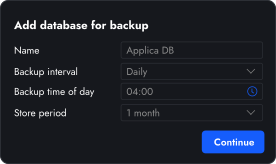
Schedule mongodump at optimal times when your application load is low. Choose hourly, daily, weekly, monthly intervals or use cron expressions for precise timing control

2

MongoDB health monitoring

MongoDB health checks

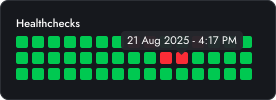
Monitor MongoDB connection availability with configurable health checks. Get notified when your database or replica set becomes unreachable

Set check intervals (every minute, 5 minutes, etc.) and failure thresholds before marking the database as unavailable

3

Store BSON archives anywhere

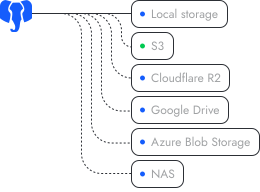
Keep MongoDB backup archives locally, in S3-compatible storage, Google Drive, Dropbox, NAS or other destinations. Your document data stays under your control. View all →

MongoDB backup storage destinations
4

Backup notifications

Get alerts when MongoDB backups complete or fail. Send notifications to your DevOps team chat or personal channels. View all →

MongoDB backup notifications
5

Self hosted via Docker

Run Databasus on your own infrastructure. All MongoDB connection strings and backup data stay on servers you control. Deploy in about 2 minutes via script, Docker or Kubernetes

Docker deployment
6

Open source and free

Databasus is fully open source with Apache 2.0 license. Inspect every line of code, fork it, contribute to it. Free for personal and enterprise use

GitHub open source
7

MongoDB versions supported

MongoDB 4, 5, 6, 7 and 8 are supported. Databasus uses the native mongodump tool for each version to ensure full compatibility with your document database

MongoDB versions
8

Access management

for teams
MongoDB backup access management

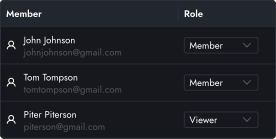
Control who can view or manage MongoDB databases. Create workspaces for different projects. Assign viewer, editor or admin roles. Read more →

9

Audit logs

for teams
MongoDB backup audit logs

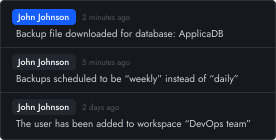
Track all activities: backup downloads, schedule changes, configuration updates. See who did what and when for compliance and accountability. Read more →

10

Security

MongoDB connection strings are encrypted with AES-256-GCM before storage. Each BSON archive is encrypted with a unique key. Credentials are passed securely to mongodump, never exposed in logs. Read more →

MongoDB backup security
11

Works with MongoDB Atlas and self-hosted

Databasus connects to cloud-hosted MongoDB databases including MongoDB Atlas, AWS DocumentDB and self-hosted deployments. Since it uses logical backups via mongodump, you only need standard connection credentials — no special cloud permissions or filesystem access required

Built on mongodump

How MongoDB backup works

While there is no single official manual titled "a new distraction phantom3dx 2021," this term appears to refer to a specialized technical field involving medical imaging phantoms and surgical distraction osteogenesis using 3D-printed models. Overview of Phantom3DX (2021)

In a medical context, a "Phantom3DX" (or 3DX phantom) is a specialized tool used to verify and calibrate 3D imaging equipment, such as MRI and CT scanners.

Purpose: It simulates human anatomy to ensure that radiation beams or surgical plans are spatially accurate.

Distraction Osteogenesis: Research from 2021 highlights the use of these phantoms to test new distraction devices—surgical tools used to slowly grow or reshape bone.

3D Technology: These phantoms are often 3D-printed based on patient CT scans to help surgeons practice complex procedures, like mandibular (jaw) distraction. Guide to Using Imaging Phantoms

If you are working with a Phantom3DX device for imaging or surgical planning, follow these general industry protocols:

Setup & Positioning: Carefully align the phantom according to the specific protocol for your imaging modality (e.g., MRI vs. CT). Misalignment can lead to "phantom images" or artifacts that skew data.

Calibration Routine: For new equipment or after maintenance, it is common to scan the phantom multiple times (e.g., four times a day for the first week) to establish a baseline for geometric accuracy.

Field of View (FOV) Testing: Use the 3DX's large FOV to check for spatial distortions at the edges of the image, which is critical for "aiming" radiation beams in cancer treatment.

Surgical Simulation: If using the phantom for distraction osteogenesis, use CAD/CAM software to design the distraction vector before practicing the actual device installation on the 3D-printed model. Potential Software References

The phrase "a new distraction" is also occasionally linked to niche software patches or fixed versions of modeling tools. If you are looking for a guide on software installation or "fixes," be cautious of unofficial sites and prioritize official documentation from vendors like Concordium Software or medical physics databases like PMC.

To draft an essay on " A New Distraction Phantom3DX 2021 ," it is important to clarify the core subject, as "Phantom3DX" typically refers to specific technical or hobbyist equipment, often associated with high-end RC drones or 3D flight simulation peripherals.

Based on current trends in tech and the release cycles of 2021, the following essay explores the "Phantom3DX" as a symbol of the digital escapism that surged during that period.

Essay: The Digital Mirage—The Phantom3DX and the 2021 Era of Distraction

IntroductionThe year 2021 was defined by a unique tension: the world was reopening, yet our reliance on digital "phantoms" had never been higher. Among the various gadgets that emerged to fill the void of social isolation, the Phantom3DX stood out as more than just a piece of hardware. Whether viewed as a high-fidelity flight peripheral or a metaphor for the year’s tech-driven escapism, it represented a "new distraction" that bridged the gap between physical confinement and digital infinity.

The Rise of the High-Fidelity EscapeIn 2021, the tech industry saw a massive spike in demand for immersive experiences. The Phantom3DX

, with its emphasis on "3D" maneuverability and precise control, catered to a generation of users looking to navigate spaces they couldn't physically visit. For flight simulator enthusiasts, it wasn't just about gaming; it was about reclaiming a sense of agency and movement. This "new distraction" offered a tactile connection to a virtual world, providing a level of immersion that simple screens could no longer satisfy. The "Phantom" Effect: Presence vs. AbsenceThe naming of the Phantom3DX

is serendipitously apt for the 2021 zeitgeist. Much of our lives during this period were lived "in phantom"—present on Zoom calls and in digital lobbies, but physically absent from the rooms we occupied. The device served as a conduit for this lifestyle. It allowed for complex, three-dimensional interaction in a year where most life was flat and two-dimensional. However, this raises a critical question: did such distractions help us cope, or did they merely postpone our re-engagement with reality?

Technological Sophistication as a Double-Edged SwordTechnically, the 2021 iteration of the Phantom3DX series pushed the boundaries of consumer-grade RF (Radio Frequency) and sensor technology. While companies like Phantom Technologies were focusing on industrial "counter-drone" solutions during the same period, the consumer side was focused on the "distraction" of flight. The sophistication of these devices made the virtual world feel more "real" than the quiet, restricted streets outside, effectively making the distraction more compelling than the reality it replaced.

ConclusionThe Phantom3DX 2021 remains a hallmark of a specific moment in history. It represents the pinnacle of our attempt to engineer our way out of boredom and isolation. As a "new distraction," it was highly successful, offering beauty and complexity in a controlled, digital environment. Yet, it also serves as a reminder of how easily we can become enamored with the "phantom" version of experience, often at the expense of the tangible world waiting outside our windows.

While there is no single established project or film widely documented under the exact title "A New Distraction Phantom3DX 2021," the components of your request suggest a focus on digital art technical soundfont creation within the creative communities of 2021.

Below is a content outline based on the technical and artistic trends of that specific period, tailored for a creative showcase or tutorial. Content: "A New Distraction" Creative Series

This series explores the intersection of 3D modeling and custom digital audio, common themes for creators using the "Phantom" or "3DX" moniker in the early 2020s. 1. Visual Showcase: The Phantom3DX Aesthetic

The year 2021 saw a massive surge in stylized 3D digital art and "digital recaps." This section would highlight the visual evolution of the project. 3D Modeling & Clipart : Leveraging tools like Vectric software

for CNC-ready 3D clipart or high-resolution texture work in flight simulators. Corel Painter & Sinix Style

: Integrating digital painting techniques, such as those popularized by artists like Sinix Design in their 2021 recaps, to add texture to 3D renders. 2. Sound Design: Creating the "Distraction"

Technical sound manipulation is a staple for content creators in this niche, particularly those using to build unique atmospheres. Custom SoundFonts

: The process involves downloading and installing specific SoundFonts into the FL Studio SoundFont Player to create custom "phantom" tones. Arrangement Evolution

: Moving from basic beats to complex arrangements, similar to the transition seen in modern guitar arrangements of classic compositions. 3. Behind the Scenes: Mobile Cinematography Content in 2021 became increasingly mobile-centric. Filmic Pro Integration : Utilizing tools like Filmic Pro v7.5

to sync remote controls and manage high-quality video streams for "set life" vlogs or project updates.

: Pairing smartphones with sliders (like the Zeapon Micro 3) and ND filters to achieve professional cinematic looks for 3D art reveals. 4. Community & Distribution : Sharing the finished work via Dritare TV

or similar storytelling platforms dedicated to unique creative voices. Podcast Discussions

: Analyzing the "bad, weird, or obscure" nature of independent digital projects on community hubs like the Cult Film Club Podcast technical tutorial for a specific software? Cult Film Club Podcast - Spotify

It seems you are looking for information on the Phantom 3DX released in 2021. While "Phantom 3DX" as a specific model name isn't a standard tech release, 2021 saw the high-profile launch of the TECNO PHANTOM X, which featured a groundbreaking 3D Borderless Screen.

Below is a blog-style overview of this "3D" distraction that reshaped the brand's image.

📱 The 2021 Pivot: How the PHANTOM X Redefined "3D" in Your Pocket

In mid-2021, the tech world saw a significant shift from a major player. TECNO stepped away from its "budget-friendly" roots to drop a flagship that was all about aesthetic distraction: the PHANTOM X. 1. The "3D" Borderless Experience

The standout feature of this device is the 3D Borderless Screen. Unlike traditional flat displays, this screen wraps around the edges at a sharp 70° angle.

Seamless Infinity: By removing the side bezels, images and text appear to "spill" over the sides, creating a fluid visual that was ahead of its time for the brand.

Tactile Grip: The 36.5° arc design was specifically engineered to ensure that despite the curved glass, the phone remains comfortable and secure in your hand. 2. Industry-First Silk Glass

The "distraction" wasn't just on the front. The PHANTOM X debuted the industry’s first curved silk glass back cover.

The Texture: It uses a series of complex etching procedures to create a surface that feels like silk but looks like sparkling glass.

Artistic Colors: Drawing inspiration from the greats, it launched in Van Gogh’s Starry Night Blue and Monet’s Summer Garden. 3. A Leap in "Ultra" Tech

Beyond the 3D looks, the 2021 Phantom aimed for professional-grade internals:

Night Owl Camera: It featured a 50MP Ultra-Night camera with a massive 1/1.3-inch sensor—taking in 33% more light than typical 108MP sensors of that era.

Selfie Power: A dual front-facing setup (48MP + 105° Ultra-Wide) made it a powerhouse for group shots and creators.

Speedy Power: With 33W Flash Charge, the 4700mAh battery could hit 70% in just 30 minutes, keeping users from being "distracted" by a dead battery for long.

Was this the "Phantom" you were looking for? If you were actually referring to a different niche device—like a 3D printer or a specific drone firmware—let me know so I can track down the exact specs! Detail3 - Phantom


2. The Ghost Benchmarking Feature

The "Phantom" in the name wasn't just marketing. The 2021 update included a hidden benchmarking suite called Poltergeist Run. It allowed users to compare their GPU’s performance against a spectral average. This turned rendering into a competitive sport. Forums exploded with screenshots of "high scores." Users would re-run the benchmark 30, 40, 50 times, overclocking fans, undervolting GPUs, searching for a 0.3-second improvement. They weren't creating art; they were chasing a phantom.

Technical Analysis (Speculative)

A reverse engineer on the now-defunct Signal Dusk forum claimed to have decompiled a Phantom3DX sample. Their notes suggested:

  • Low-level GPU hooking to induce micro-saccadic eye movements via rapid, sub-visible screen flicker (60.1 Hz offset)
  • Auditory driving using binaural beats in the theta-gap range (5–7 Hz) masked as system notification sounds
  • A self-terminating process that left no logs but altered user’s time perception by ~3–7% (measured via reaction-time tests)

The same analyst noted the binary was timestamped March 2021 and contained a single plaintext string:
distraction is the new attention

3. The Procedural Grain Paradox

One of the flagship features was a proprietary noise algorithm that generated infinite, non-repeating grain textures. It was marketed for "hyper-realistic analog film emulation." In practice, it became a slot machine. You would hit "Randomize Grain" and wait for the dopamine hit of a beautiful pattern. Then you’d hit it again. And again. Designers reported spending entire afternoons just watching grain generate, convincing themselves it was "research."

Why It Was "A New Distraction" Unlike Any Other

Before 2021, distractions were passive: social media scrolling, clickbait headlines, or YouTube rabbit holes. Phantom3DX 2021 introduced active distraction. It was a tool masquerading as a toy, or perhaps a toy masquerading as a tool. Here is what made it so dangerously compelling:

The Genesis of the Ghost

To understand the distraction, you must first understand the vacuum. 2021 was a year of hybrid work. Professionals sat alone in home offices, their Zoom reflexes sharpened, their tolerance for boredom at an all-time low. Enter the Phantom3DX ecosystem.

Originally launched as a niche physics-based rendering engine, Phantom3DX had spent years playing second fiddle to industry giants like Unreal Engine and Blender. But the 2021 update changed everything. Developers didn't just add features; they weaponized curiosity. The release notes were 47 pages long, filled with cryptic terms like "Spectral Volumetric Cascades," "Neural Denoising LODs," and "Reactive Grain Synthesis."

For the creative mind, these aren't just bullet points. They are siren songs.

Key Features of the 2021 Release

The 2021 update introduced several features designed to counter modern Advanced Persistent Threats (APTs):

1. High-Fidelity Lures The platform creates "breadcrumbs" on real production machines. These are small bits of data (like saved credentials or browser history) that point toward the Phantom network. Attackers following these trails inadvertently lead defenders right to themselves.

2. Automated Incident Response When an attacker interacts with a Phantom3dx decoy, the system does not just alert the security team; it triggers an automated containment protocol. Because the attacker is already in an isolated environment, the system can capture their tools, tactics, and procedures (TTPs) without risking the actual network.

3. Intelligence Gathering Unlike a firewall that simply blocks an IP address, Phantom3dx is designed for intelligence gathering. It profiles the attacker, capturing keystrokes, uploaded malware, and command-and-control IP addresses. This allows organizations to understand who is attacking them and why.

What is Phantom3dx?

Phantom3dx is a next-generation Deception Platform. In cybersecurity terms, a "distraction" is not a nuisance; it is a strategic lure designed to mislead attackers, waste their time, and reveal their presence.

Released in its major 2021 iteration, Phantom3dx creates a parallel network environment—a " Phantom" network—that mimics the topology, traffic patterns, and data assets of a real corporate infrastructure. To a hacker scanning for vulnerabilities, the Phantom3dx environment looks identical to the production network, but it is entirely isolated and instrumented for detection.
MongoDB database

Official MongoDB backup via mongodump with gzip compression, encryption and cloud storage

Get started

How to install?

Databasus supports multiple installation methods. Deploy on your VPS, local machine or Kubernetes cluster in about 2 minutes. Same installation works for MongoDB, PostgreSQL, MySQL and MariaDB backups

Automated script (recommended)
The installation script will install Docker with Docker Compose (if not already installed), set up Databasus and configure automatic startup on system reboot.
sudo apt-get install -y curl && \
sudo curl -sSL https://raw.githubusercontent.com/databasus/databasus/refs/heads/main/install-databasus.sh | sudo bash
Read more about installation
How to install Databasus
FAQ

MongoDB backup questions

Common questions about backing up MongoDB document databases with Databasus. If you have other questions, join our community on Telegram

1

What is Databasus and how does it backup MongoDB databases?

Databasus is an Apache 2.0 licensed, self-hosted backup tool that uses mongodump under the hood to create consistent MongoDB backups. It wraps mongodump with a modern web interface, automated scheduling, cloud storage integration (S3, Google Drive, Dropbox), real-time notifications (Slack, Discord, Telegram) and AES-256-GCM encryption — eliminating the need for custom shell scripts and cron jobs.
2

Does Databasus support MongoDB replica sets?

Yes, Databasus fully supports MongoDB replica sets. You can connect to any member of a replica set using the standard MongoDB connection URI format with replica set options. Databasus will read from the specified node, allowing you to backup from secondary nodes to reduce load on your primary. This is particularly useful for production environments where you want to avoid impacting primary node performance.
3

Can I backup MongoDB Atlas databases with Databasus?

Yes, Databasus works seamlessly with MongoDB Atlas. Since Databasus uses logical backups via mongodump, it only requires standard MongoDB connection credentials — no special Atlas permissions, IP whitelisting beyond your Databasus server, or administrative roles needed. Just provide your Atlas connection string (available in the Atlas dashboard) and Databasus handles the rest.
4

Which MongoDB versions does Databasus support?

Databasus supports MongoDB versions 4, 5, 6, 7 and 8. All backups use the native mongodump tool with --archive and --gzip flags for efficient, compressed BSON archives. The archives can be restored using mongorestore to any compatible MongoDB version, making migrations between versions straightforward.
5

How does Databasus handle large MongoDB collections?

Databasus streams mongodump output directly to your storage destination, optionally encrypting the stream in transit. This approach avoids writing temporary files to disk, making it efficient for databases with large collections. The --archive flag creates a single compressed file rather than a directory structure, reducing I/O overhead and simplifying storage management.
6

Can I backup sharded MongoDB clusters with Databasus?

Databasus currently focuses on backing up individual MongoDB databases rather than coordinated sharded cluster backups.

For sharded clusters, you can:

• Backup each shard individually by connecting to shard replica sets
• Backup via a mongos router (though this may impact performance)

For production sharded clusters, consider MongoDB Atlas native backups or mongodump with --oplog for point-in-time consistency across shards.
7

How does Databasus secure MongoDB credentials and backups?

Databasus implements multi-layer security:

1. Credential encryption: All MongoDB connection URIs, passwords and authentication details are encrypted with AES-256-GCM before storage.

2. Backup encryption: Each BSON archive is encrypted with a unique key derived from master key, backup ID and random salt.

3. Secure credential handling: Connection URIs are passed directly to mongodump via secure parameters, never exposed in logs or process listings.
8

Does Databasus support incremental MongoDB backups or oplog tailing?

Databasus focuses on full logical backups using mongodump rather than incremental backups or oplog-based point-in-time recovery. For most use cases, scheduled full backups (hourly, daily, weekly) provide sufficient recovery points without the complexity of oplog management. MongoDB Atlas already offers native continuous backups with point-in-time recovery, and external incremental backups cannot be easily restored to Atlas clusters.
9

Can I restore MongoDB backups to a different version or cluster?

Yes, since Databasus creates standard mongodump archives in BSON format, you can restore them to any compatible MongoDB server — different version, different cloud provider or local development machine. Download the backup from Databasus (automatically decrypted), then use mongorestore with --archive and --gzip flags. Databasus shows the exact restore command for each backup.
10

How does mongodump compression work in Databasus?

Databasus uses mongodump's built-in --gzip flag which compresses BSON data during the dump process. This typically reduces archive size by 60-80% compared to uncompressed BSON. The compression happens in the mongodump stream before optional encryption, so both compressed and encrypted archives remain efficient. Decompression is automatic when using mongorestore with the --gzip flag.
11

Can I backup specific MongoDB collections instead of entire databases?

Currently, Databasus backs up entire MongoDB databases rather than individual collections. This ensures you have complete, consistent backups including all collections, indexes and metadata. If you need collection-level backups, you can create separate databases for different data domains, each with its own backup schedule in Databasus.
12

Does Databasus work with MongoDB running in Docker or Kubernetes?

Yes, Databasus connects to MongoDB over the network using standard connection URIs, so it works with MongoDB regardless of where it's deployed — Docker containers, Kubernetes pods, VMs or bare metal. Just ensure network connectivity between Databasus and your MongoDB instance. For Kubernetes deployments, you can use internal service DNS names or external load balancer endpoints.