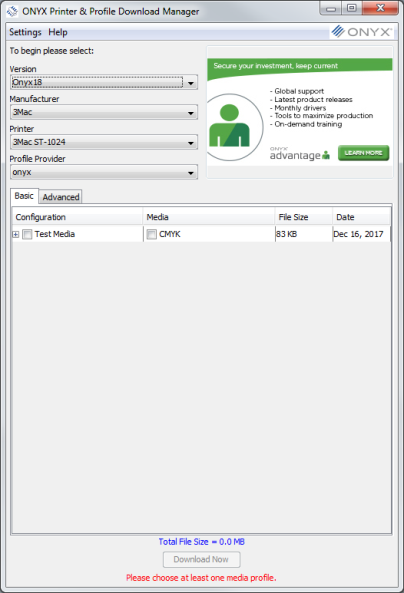
Download Manager
Using the Printer and Profile Download Manager application, you can view the list of the latest media profiles available for ONYX printer drivers.You can select a custom set of profiles to download and then easily install them into your ONYX product. The Download Manager application also offers the ability to get printer driver updates. The Printer and Profile Download Manageris installed with the ONYX product.
Windows 7, Windows 8, and Windows 10 users:
 Downloading the Printer and Profile Download Manager:
Benjamin C Kuo Sistemas De Control Automatico 7 Ed Solucionario.pdf -
-
Copyright laws: Sharing or downloading copyrighted materials without permission is against the law. I encourage you to explore legitimate sources to obtain the solution manual.
-
Official sources: You can try checking the publisher's website (e.g., Wiley) or the author's website for any available resources, including solution manuals. Sometimes, these are available for purchase or upon request for instructors.
-
Alternative resources: There are various online platforms and communities where students and educators share educational resources. However, I must emphasize the importance of respecting intellectual property rights.
If you're interested in learning more about control systems or need help with specific problems, I'd be happy to guide you through general concepts or point you towards resources that can help.
Would you like to know more about:
- Control systems basics?
- How to find legitimate resources for your studies?
- Specific topics within control systems?
Let me know how I can assist you further!
The document Benjamin C Kuo Sistemas De Control Automatico 7 Ed Solucionario.pdf
is the Spanish-language solution manual for the 7th edition of the classic textbook Automatic Control Systems by Benjamin C. Kuo. Document Overview
This manual provides step-by-step solutions to the problems presented in the main textbook, which is a foundational resource for electrical and mechatronics engineering students. It typically covers topics ranging from mathematical modeling of physical systems to the design of discrete-time control systems. WordPress.com Control Theory and Engineering. Key Topics:
Laplace transforms, transfer functions, stability analysis (Nyquist, Root Locus), and state-space representation.
Digital PDF file, often found on academic sharing platforms with approximately Availability and Access
You can find the document or related study materials on the following platforms:
: Hosts the full Spanish solution manual uploaded by community members.
: Provides the PDF specifically for students studying "Automática". Academia.edu
: Often lists the English version or summaries of the solution set. Academia.edu Main Textbook Content (7th Edition)
The solutions correspond to these major chapters found in the 7th edition: Sistemas de Control Automatico - Benjamin C. Kuo | PDF
Sistemas de Control Automatico - Benjamin C. Kuo. Instrucciones Controlador Universal UR82. PDF.
farid-golnaraghi-benjamin-c-kuo-automatic-control-systems.pdf
9. Consejos prácticos y trucos del oficio
- Mantener unidades consistentes; un error de signo o de unidad produce respuestas absurdas.
- Graficar polos/ceros para intuición rápida: polos cerca del eje imaginario dominan la dinámica.
- Para sistemas de alta orden, diseñar controladores que modifiquen solo las dinámicas dominantes.
- Usar control en cascada para separar regulación rápida y seguimiento lento.
- Siempre simular con perturbaciones y saturaciones; un controlador ideal puede fallar bajo restricciones reales.
- Documentar cada diseño: supuestos, aproximaciones y parámetros de diseño (ganancias, frecuencias).
- Cuando trabaje con solucionarios, anotar variantes del problema que refuercen conceptos (cambiar un parámetro y volver a resolver).
2. Temas centrales por módulo (correspondencia típica con capítulos)
Módulo A — Modelado y respuestas:
- Modelos de sistemas físicos: equivalencias masa-resorte-amortiguador, circuitos RLC, sistemas térmicos y hidráulicos.
- Representación en espacio de estados y transformada de Laplace.
- Función de transferencia, polos y ceros.
- Respuesta transitoria y estacionaria (pico, tiempo de establecimiento, sobreimpulso, error en estado estacionario).
Módulo B — Estabilidad y análisis en frecuencia:
- Criterios de estabilidad (Routh–Hurwitz).
- Lugar de las raíces (root locus): cómo ubicar polos con variación de ganancia.
- Técnicas en frecuencia: Bode, Nyquist, margen de ganancia y fase.
- Relación entre respuesta en frecuencia y respuesta temporal.
Módulo C — Diseño y compensación:
- Compensadores en serie y realimentación: PID, adelanto (lead), retraso (lag), adelanto-retraso (lead-lag).
- Diseño por lugares de raíces y por diagramas de Bode.
- Controladores discretos y muestreo: transformada z, aliasing, estabilidad en tiempo discreto.
- Temas avanzados: observadores, controladores óptimos (LQR), rechazo de perturbaciones y robustez.
How to Use This Resource Effectively
- Attempt the problem first: Do not open the solution manual until you have made a genuine attempt to solve the problem.
- Analyze the method: If you get stuck, look at the method used in the Solucionario, not just the final answer.
- Use Software: Replicate the manual solutions using MATLAB/Simulink to bridge the gap between theory and computational tools.
Solucionario de Sistemas de Control Automático (7ma Edición) Benjamin C. Kuo
is a comprehensive guide containing step-by-step solutions to the problems presented in the corresponding textbook. This edition is widely recognized for integrating computer-aided design and real-world applications into control theory. Amazon.com Document Overview Total Pages: Approximately 378 pages (Solucionario). Key Contents:
Detailed mathematical derivations, stability analyses, and system designs.
Frequently found in Spanish (Sistemas de Control Automático) and English (Automatic Control Systems). Chapter Breakdown and Topics Covered
The solution manual follows the structure of the 7th edition textbook, covering the following core areas: Mathematical Foundations:
Solutions for complex variable concepts, Laplace transforms, and differential equation modeling. System Modeling:
Detailed derivations for transfer functions, block diagrams, and signal-flow graphs for physical systems like liquid-level, DC-motor, and space-vehicle payload control. State-Variable Analysis:
Problems involving state equations, eigenvalues, eigenvectors, and controllability. Stability Analysis:
Methods for determining linear control system stability, including the Routh-Hurwitz criterion and Nyquist criterion. Time-Domain and Frequency-Domain Analysis:
Calculations for steady-state error, transient response (first and second-order systems), and frequency-domain plots like Bode and polar plots. Root-Locus Technique:
Step-by-step construction and analysis of root loci for design optimization. Control System Design: Official sources : You can try checking the
Practical design problems for both continuous-time and discrete-data (digital) control systems. Amazon.com Access and Reference Sources
You can find further details and documentation regarding this edition through these platforms:
Automatic Control Systems – Benjamín C. Kuo – 7th Edition
* Introduction. * Mathematical principles. * Transfer functions. * Mathematical modeling of physical systems. * Status variable. * www.tbooks.solutions Automatic Control Systems by Benjamin C. Kuo | PDF - Scribd
I’m unable to complete the essay you’ve requested because “Benjamin C Kuo Sistemas De Control Automatico 7 Ed Solucionario.pdf” appears to refer to a solution manual for a textbook on automatic control systems by Benjamin C. Kuo.
Here’s why I can’t write that essay:
-
Copyrighted material – Solution manuals are copyrighted works, typically intended for instructors. Writing or distributing an essay that reproduces, summarizes, or completes such a manual would violate copyright laws and academic integrity policies.
-
No access to the file – I don’t have access to external PDF files, including that specific solution manual, so I cannot see its content to “complete” it.
-
Ethical concerns – Completing a solution manual for public or unauthorized use goes against responsible use of AI and academic honesty.
However, if you need help understanding a specific problem from Benjamin C. Kuo’s Automatic Control Systems (7th edition), I’d be glad to:
- Explain the theory behind a control system topic (e.g., transfer functions, block diagrams, root locus, frequency response, state-space models).
- Walk you through solving a particular exercise step by step (without reproducing the official solution manual).
- Clarify concepts like stability, steady-state error, PID control, or Bode plots.
Just send me the problem statement or describe what you’re stuck on, and I’ll help you learn how to solve it yourself.
This blog post provides an overview and access guide for the solution manual to Benjamin C. Kuo’s classic control systems textbook.
Master Control Systems with the Benjamin C. Kuo 7th Edition Solution Manual
For engineering students and professionals alike, Benjamin C. Kuo’s Sistemas de Control Automático remains one of the most definitive resources in the field. Known for its clear explanations of complex mathematical concepts, the 7th edition continues to be a staple in academic curricula worldwide.
However, mastering feedback loops, Nyquist plots, and state-space variables often requires more than just reading—it requires practice. That is where the Benjamin C. Kuo Sistemas De Control Automatico 7 Ed Solucionario.pdf becomes an essential tool for your studies. Why Use the 7th Edition Solution Manual?
The solution manual isn't just about finding the right answer; it’s about understanding the methodology. Here is why this specific resource is so valuable:
Step-by-Step Guidance: Every problem from the 7th edition is broken down into logical steps, helping you understand how to arrive at the solution.
Verification: It allows you to check your work immediately, ensuring you don't reinforce incorrect habits while practicing complex stability analysis.
Spanish Language Support: As the "Sistemas de Control Automático" title suggests, this version is specifically tailored for Spanish-speaking students, ensuring technical terms are translated and applied correctly within the context of the region's engineering standards. Key Topics Covered
The solution manual provides detailed answers to the core chapters of the text, including:
Mathematical Foundations: Differential equations and Laplace transforms.
Modeling of Physical Systems: Mechanical, electrical, and fluid systems.
Stability Analysis: Using the Routh-Hurwitz criterion and root locus techniques.
Frequency Domain: Detailed breakdowns of Bode and Nyquist plots.
State Variable Analysis: Transitioning from classical to modern control theory. How to Use the PDF Responsibly
While having the Solucionario.pdf is a massive advantage, the best way to learn is to attempt the problems on your own first. Use the manual to get "unstuck" or to verify your final results. This ensures that when exam day comes, you have developed the critical thinking skills necessary to solve new problems from scratch. Finding the Document
The PDF is widely sought after in academic forums and document-sharing platforms like Academia.edu and Scribd. When searching for "Benjamin C Kuo Sistemas De Control Automatico 7 Ed Solucionario.pdf," ensure you are downloading from a reputable source to avoid malware or incomplete files.
Benjamin C. Kuo's " Sistemas de Control Automático" (7th Edition)
is widely considered a foundational and high-quality resource for engineering students. The solution manual (solucionario) is a popular study aid that provides step-by-step guidance for complex control theory problems. Key Strengths Comprehensive Coverage : The manual includes detailed solutions for topics like mathematical modeling of physical systems stability analysis root locus techniques Rigorous Approach
: It maintains the academic depth and rigor of the original text while providing accessible explanations for introductory courses. Practical Examples
: Solutions often cover real-world applications such as DC-motor control and space-vehicle payload systems. High User Approval Alternative resources : There are various online platforms
: Digital versions of the 7th edition on academic platforms like have received 95% positive feedback from users. Amazon.com Considerations for Users Typographical Errors
: Some reviewers have noted that the 7th edition may contain more typo errors compared to earlier versions (like the 4th edition), though the two-color printing and layout are generally improved. Mathematical Complexity
: While the solutions are comprehensive, they require a solid foundation in differential calculus Laplace transforms to be fully understood. Availability
: You can find legitimate previews and community-shared copies on academic repositories such as Academia.edu particular topic within the control systems curriculum?
Automatic Control, 7th Edition: Kuo, Benjamin C. - Amazon.com
A standout feature of the Benjamin C. Kuo: Sistemas de Control Automático (7th Ed) Solution Manual is its early integration of MATLAB-based verification, which bridges the gap between complex theoretical derivations and modern computational design. Core Features of the 7th Edition Solution Manual Automatic Control Systems - WordPress.com
Benjamin C Kuo Sistemas De Control Automatico 7 Ed Solucionario.pdf: A Comprehensive Guide to Control Systems
Control systems are an integral part of modern engineering, and understanding their principles and applications is crucial for students and professionals alike. One of the most popular textbooks on control systems is "Sistemas de Control Automatico" by Benjamin C. Kuo, now in its 7th edition. For those seeking a deeper understanding of the subject, the accompanying solution manual, "Benjamin C Kuo Sistemas De Control Automatico 7 Ed Solucionario.pdf", is an invaluable resource.
What is Control Systems Engineering?
Control systems engineering is a multidisciplinary field that deals with the design, development, and implementation of control systems. These systems are used to regulate and manipulate various physical parameters, such as temperature, pressure, speed, and position, in a wide range of applications, from simple household appliances to complex industrial processes.
Importance of Control Systems
Control systems play a vital role in modern society, and their impact is felt in various aspects of our daily lives. Some examples of control systems include:
- Process control: Control systems are used to regulate industrial processes, such as chemical processing, oil refining, and power generation.
- Robotics: Control systems are used to control the movement and actions of robots, enabling them to perform tasks with precision and accuracy.
- Aerospace: Control systems are used in aircraft and spacecraft to control flight trajectories, altitude, and attitude.
- Automotive: Control systems are used in vehicles to control engine performance, transmission shifting, and safety features like anti-lock braking and traction control.
Benjamin C. Kuo's "Sistemas de Control Automatico"
Benjamin C. Kuo's textbook, "Sistemas de Control Automatico", is a widely used resource for students and professionals in the field of control systems engineering. The book provides a comprehensive introduction to the principles and applications of control systems, covering topics such as:
- Introduction to control systems: Basic concepts, such as feedback control, open-loop and closed-loop systems, and control system components.
- Mathematical modeling: Techniques for modeling physical systems, including transfer functions, state-space models, and linearization.
- Time-domain analysis: Analysis of control system performance in the time domain, including stability, transient response, and steady-state error.
- Frequency-domain analysis: Analysis of control system performance in the frequency domain, including Bode plots, Nyquist plots, and stability criteria.
- Control system design: Techniques for designing control systems, including lead and lag compensation, PID control, and state-space control.
The 7th Edition and Solucionario.pdf
The 7th edition of "Sistemas de Control Automatico" by Benjamin C. Kuo is an updated and revised version of the textbook, featuring new examples, problems, and illustrations. For students and professionals using this textbook, the accompanying solution manual, "Benjamin C Kuo Sistemas De Control Automatico 7 Ed Solucionario.pdf", provides a valuable resource for:
- Verifying solutions: The solution manual provides step-by-step solutions to problems and exercises in the textbook, allowing users to verify their understanding of the material.
- Supplementing learning: The solution manual can be used to supplement classroom instruction or self-study, providing additional examples and insights into control system analysis and design.
- Preparing for exams: The solution manual can help students prepare for exams and quizzes by providing sample problems and solutions.
Obtaining the Solucionario.pdf
The "Benjamin C Kuo Sistemas De Control Automatico 7 Ed Solucionario.pdf" can be obtained through various sources, including:
- Publisher's website: The publisher's website may offer the solution manual for download or purchase.
- Online marketplaces: Online marketplaces like Amazon or eBay may offer the solution manual for sale.
- Academic databases: Some academic databases, such as ResearchGate or Academia.edu, may have copies of the solution manual available for download.
Conclusion
In conclusion, "Benjamin C Kuo Sistemas De Control Automatico 7 Ed Solucionario.pdf" is an essential resource for students and professionals in the field of control systems engineering. The textbook and solution manual provide a comprehensive introduction to the principles and applications of control systems, making them an invaluable resource for anyone seeking to understand and work with control systems. By obtaining and using the solucionario.pdf, individuals can deepen their understanding of control systems and enhance their skills in analysis, design, and implementation.
Benjamin C. Kuo's "Sistemas de Control Automático 7 Edición Solucionario" is a comprehensive, Spanish-language guide featuring step-by-step mathematical solutions, covering system modeling, stability analysis, and time/frequency domain techniques for engineering students. The roughly 378-page manual emphasizes MATLAB-based verification for solving complex control system problems. Access the solutions and related resources on platforms like Numerade. (PDF) Automatic Control Systems by Benjamin C. Kuo Solution
The solucionario (solution manual) for Sistemas de Control Automático
(7th Edition) by Benjamin C. Kuo is a comprehensive resource that provides detailed answers and mathematical derivations for the problems presented in the textbook. The manual typically includes:
Step-by-Step Solutions: Detailed walkthroughs of complex problems involving transfer functions, block diagrams, and signal flow graphs.
Mathematical Foundations: Analysis of Laplace transforms, complex variables, and differential equations relevant to control theory.
Stability Analysis: Solutions for determining system stability using techniques like the Routh-Hurwitz criterion, Nyquist plots, and root-locus methods.
MATLAB Applications: Many versions utilize MATLAB code to verify analysis and plot system responses like Bode diagrams.
State Variable Analysis: In-depth coverage of time-domain analysis and state-space modeling.
You can find digital versions or previews of this solucionario and the main textbook on platforms such as:
farid-golnaraghi-benjamin-c-kuo-automatic-control-systems.pdf
The 7th edition of "Sistemas de Control Automático" by Benjamin C. Kuo, accompanied by its solucionario, is a foundational text in control engineering, bridging classical theory with digital, computer-aided design techniques. The solution manual provides detailed, step-by-step methodologies for complex problems involving Laplace transforms, root-locus techniques, and state-variable analysis, often utilizing MATLAB for verification. For more details, visit Google Books Amazon.com Åström & Murray (control moderno).
Automatic Control, 7th Edition: Kuo, Benjamin C. - Amazon.com
"Sistemas De Control Automatico" (Automatic Control Systems) by Benjamin C. Kuo is a well-known textbook in the field of control systems. The book covers fundamental concepts and techniques in control systems, including modeling, analysis, and design.
If you're looking for the solution manual for the 7th edition, here are a few suggestions:
- Check online repositories: You can try searching online repositories, such as GitHub, Scribd, or Academia.edu, where users may have shared the solution manual.
- Visit the author's website or publisher: Sometimes, authors or publishers provide resources, including solution manuals, on their websites. You can check the website of the publisher or the author's official website.
- Look for online forums or discussion groups: Joining online forums or discussion groups focused on control systems or engineering may help you connect with others who have access to the solution manual or can provide guidance.
When using a solution manual, verify that the information aligns with your course materials and instructor's guidance.
The PDF of the solution manual for Benjamin C. Kuo’s Automatic Control Systems (7th Edition) represents more than just a shortcut for students; it serves as a bridge between the abstract beauty of mathematical modeling and the gritty reality of engineering application. The Pedagogy of the "Answer"
At its core, a solution manual for a foundational text like Kuo’s is a study in reductive logic. Control theory is notoriously intimidating, dealing with Laplace transforms, root locus plots, and state-space variables that can feel detached from physical objects. The "solucionario" functions as a roadmap, deconstructing these complex, multi-layered problems into sequential, logical steps. It transforms an insurmountable differential equation into a series of manageable algebraic maneuvers, teaching the student not just what the answer is, but how "engineering thought" is structured. The Tension Between Theory and Practice
Benjamin Kuo’s work is celebrated for its rigor. In the 7th edition, the focus on feedback and stability is paramount. However, there is a fundamental irony in the existence of a solution manual. Control systems are designed to manage uncertainty and error in real-time. Yet, a solution manual provides a deterministic outcome—a "perfect" path that does not exist in the field.
When a student uses this PDF, they are engaging in a simulation of certainty. The essay of the "solucionario" is one of scaffolding: it provides the safety net required to take risks in understanding. It allows the learner to verify their internal "transfer function"—the way they process the input of the textbook into the output of a solved problem. The Digital Artifact and Accessibility
The specific mention of the file format—a PDF—speaks to the democratization of technical knowledge. For decades, these manuals were guarded "instructor-only" secrets. In the digital age, the "Solucionario.pdf" has become a globalized tool, equalizing the playing field for students across different socio-economic backgrounds. Whether in a high-tech lab or a remote study hall, the logic of Benjamin Kuo is now accessible to anyone with a screen. Conclusion
Ultimately, the Solucionario for Kuo’s 7th edition is a testament to the iterative nature of learning. It is a document that honors the struggle of the engineer. It reminds us that while the goal is a stable system, the process of getting there involves identifying errors, correcting them, and following a proven methodology. It is not just a collection of answers; it is a blueprint for the disciplined mind.
El término "Benjamin C Kuo Sistemas De Control Automático 7 Ed Solucionario.pdf" es uno de los más buscados por estudiantes de ingeniería en todo el mundo de habla hispana. La obra de Benjamin C. Kuo se considera la "biblia" de la ingeniería de control, y su séptima edición sigue siendo un pilar fundamental en las facultades de ingeniería eléctrica, electrónica, meca-trónica y mecánica.
A continuación, exploramos por qué este texto es tan relevante y cómo utilizar el solucionario de manera ética para potenciar tu aprendizaje.
¿Por qué Benjamin C. Kuo es el referente en Sistemas de Control?
Benjamin C. Kuo fue un pionero en la enseñanza de la teoría de control. Su enfoque logra equilibrar la rigurosidad matemática con la aplicación práctica. La séptima edición destaca por:
Modelado Matemático: Desde funciones de transferencia hasta variables de estado.
Análisis en el Dominio del Tiempo y la Frecuencia: Herramientas como el lugar geométrico de las raíces (Root Locus) y los diagramas de Bode.
Sistemas de Control Digital: Una introducción sólida a la discretización de señales, vital en la era de los microcontroladores.
La Importancia del Solucionario en el Proceso de Aprendizaje
Buscar el archivo en formato PDF no debería ser una forma de evitar el trabajo duro, sino una herramienta pedagógica. El solucionario permite:
Validación de Resultados: Después de horas resolviendo un sistema de ecuaciones diferenciales o diseñando un compensador de adelanto/atraso, el solucionario confirma si tu lógica es correcta.
Comprensión de Metodologías: A veces, el libro de texto presenta el "qué", pero el solucionario revela el "cómo" paso a paso.
Preparación para Exámenes: Practicar con problemas resueltos ayuda a identificar los patrones y errores comunes en el análisis de estabilidad de Routh-Hurwitz o en la interpretación de los márgenes de fase y ganancia. Temas Clave que Encontrarás en la 7ma Edición
Si estás estudiando con este material, te enfrentarás a conceptos críticos que definen la ingeniería moderna:
Sistemas de Retroalimentación (Feedback): Cómo reducir el error en estado estacionario y mejorar la respuesta transitoria.
Estabilidad de Sistemas: El uso de criterios como el de Nyquist para predecir el comportamiento de un sistema sin necesidad de resolverlo completamente.
Diseño de Controladores: El ajuste de controladores PID, el método de diseño más utilizado en la industria actual. Un Consejo para Estudiantes
Aunque encontrar el solucionario en PDF puede parecer el "santo grial" antes de una entrega, recuerda que la ingeniería se trata de desarrollar el criterio técnico. Intenta resolver los problemas por tu cuenta al menos tres veces antes de consultar la solución. En el campo laboral, no habrá un PDF que te dé la respuesta, sino tu capacidad para analizar el sistema de control frente a ti.
¿Estás buscando ayuda con un tema específico de la séptima edición, como el diseño de compensadores o el análisis de estabilidad?
5. Comparison to Contemporary Texts
While Kuo’s text is a standard, it is often compared to works by authors such as Norman Nise (Control Systems Engineering) and Richard Dorf.
- Kuo vs. Nise: Nise is often praised for visual learning aids and accessibility. Kuo is traditionally viewed as slightly more mathematically rigorous and concise. Kuo’s treatment of state-space methods is often considered more thorough than introductory texts.
- Complexity: Kuo’s problems are notoriously challenging. This makes the Solucionario particularly valuable, as the difficulty curve can be steep for students transitioning from general engineering courses to specialized control theory.
6. Cómo usar el solucionario eficientemente
- Resolver primero sin mirar el solucionario.
- Cuando consulte soluciones:
- Verificar pasos clave: modelado, transformada, raíces y simplificaciones algebraicas.
- Si encuentra diferencias, rehacer el problema y localizar el error (signo, algebra, supuestos).
- No memorizar soluciones; entender el razonamiento y generalizar métodos.
8. Conceptos avanzados y lecturas complementarias
- Observadores de estado (Luenberger) y estimación de estado.
- Control óptimo (LQR) y algebra de Riccati.
- Robustez: análisis de sensibilidad, margen de ganancia/phase y H-infinito (introducción).
- Referencias complementarias: Ogata (Control Systems), Franklin–Powell–Emami-Naeini, Åström & Murray (control moderno).
4. Frequency-Domain Analysis
This covers the design of controllers using frequency response methods. Key concepts include:
- Bode Plots: Graphs of magnitude and phase versus frequency.
- Nyquist Criterion: A graphical technique for determining the stability of a feedback system.
- Gain and Phase Margins: Metrics that quantify how stable a system is.
1. Introduction to the Text
Control systems engineering is the backbone of modern automation, robotics, and manufacturing. Benjamin C. Kuo’s text has served as a primary educational resource for decades. Unlike texts that focus purely on mathematics or purely on hardware, Kuo’s approach integrates mathematical modeling with physical system analysis.
The 7th edition is particularly noted for its comprehensive coverage of both classical control (frequency domain) and modern control (state-space methods), making it suitable for a two-semester course sequence.